


The Brushstroke Revolution: How Titian Freed Painting from the Tyranny of Line
Introduction
What is painting? Most of us would think of lines that separate shapes from their background. But in the middle of the sixteenth century, an elderly man in Venice quietly and steadily set about demolishing that very assumption. His name was Titian, and what he did changed painting forever.
Titian grasped something simple yet profound: the line does not have to be the absolute ruler. He saw that the human eye, before it can identify the precise boundary of a form, is already lost in the play of light and colour. So he began to paint in a way no one before him had dared.
1. Transparent Layering (Glazing)
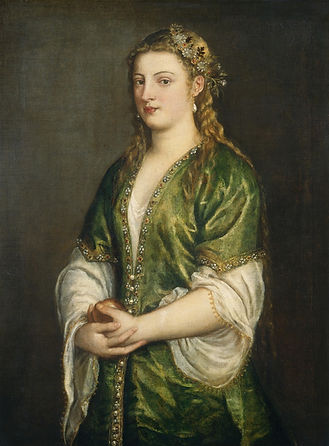
Instead of spreading thick, uniform colour across the canvas, Titian built up thin, transparent layers of oil paint, one on top of another. Each layer was allowed to dry before the next was applied. The final result was a luminous, trembling depth, as if the colour were glowing from within. This is why the skin of the women in Titian's paintings, such as the Venus of Urbino, seems to breathe rather than sit on the surface as a flat, lifeless mask.
2. Painterly Brushwork
In Florence, a painter would first make a meticulous drawing in charcoal or ink, then fill it in with colour. But Titian, especially in his late career, drew directly with the brush, using patches of colour. His brushstrokes were no longer hidden; they became part of the beauty of the work. Some of his late paintings look so loose and unfinished that the viewer feels the artist was working right before their eyes.
3. Blending Colours on the Canvas
Titian did not fully mix his colours on the palette. Instead, he placed them side by side directly on the canvas, then blended them softly with a brush. This method created gentle, seamless transitions that later came to be known as sfumato. In his landscapes, the sky, clouds and earth melt into one another so smoothly that you cannot find where one ends and the other begins.
Three Techniques That Titian Invented (or Perfected)
The Legacy of Titian: From Rubens to Renoir
The impact of this revolution cannot be overstated. In the seventeenth century, Rubens, who was in many ways Titian's heir in northern Europe, carried Titian's free brushwork to new heights. In the nineteenth century, Delacroix, the leader of French Romanticism, called Titian "the god of painters". It was with these very techniques that he rebelled against the dry linearity of Neoclassical painting.
But perhaps Titian's greatest inheritance can be found at the heart of Impressionism. When Monet and Renoir placed broken, separate brushstrokes on their canvases, they were unknowingly continuing a tradition that Titian had established in his final years. That tradition can be summed up as follows: painting means capturing what the eye sees in a single moment, not what reason has drawn in advance.
Titian taught later painters that sometimes releasing the brush from the bondage of line brings you closer to truth than confining every particle within a sharp boundary. He showed that a single patch of colour, placed correctly, can convey more "life" than the most precise and sharp edged line. And that is why, even today, when we look at an abstract painting or an Impressionist work, we see, without knowing it, the shadow of that old Venetian on the wall.