


THE FIRST HUMAN IMAGE IN PHOTOGRAPHY: A PRODUCT OF TECHNICAL CONSTRAINT AND AN UNFORESEEN INCIDENT
The Accidental Landmark
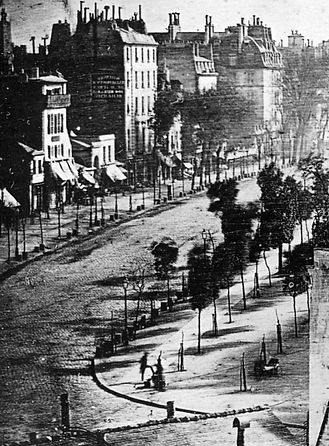
In 1838, Louis Daguerre, while refining the daguerreotype process, aimed his camera at the Boulevard du Temple in Paris. The technology of that era had a fundamental limitation: silver‑plated sheets had low light sensitivity, requiring an exposure time of typically 10 to 15 minutes. Any moving object (a horse, a carriage, a pedestrian) would vanish during that interval, leaving no trace. The logical result was an image showing a nearly empty street.
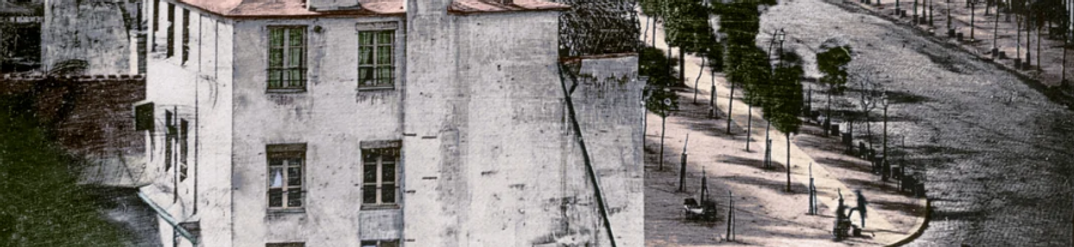
But in the lower left corner of the frame, an unforeseen event occurred that changed the course of history. A man had stopped to have his shoes shined. The relative stillness of both him and the bootblack coincided with the camera’s long exposure time.
While thousands of other people were passing along the boulevard at that very moment and left no record of themselves, this man became the first human ever recorded in a photograph, simply because of an enforced pause. This was not a conscious artistic choice. It was the accidental intersection of a personal need (a shoeshine) and a systemic constraint (long exposure time).
Thus, the first recorded human image in the history of photography was neither intended nor planned. It emerged at the crossroads of two factors: a technical limitation (lengthy exposure) and an unforeseen incident (stopping to have shoes shined).
Not Planned, But Emerged: The Accidental First Human Photograph
Daguerreotype Techniques of the Era
To better understand this event, a brief look at the photographic technology of those years is helpful:
-
Basic process: In the daguerreotype, a thin copper plate was coated with a layer of silver. The plate was then exposed to iodine vapor to form a light‑sensitive layer (silver iodide).
-
Exposure: The sensitized plate was placed inside a box camera. Depending on lighting and lens aperture, exposure time ranged from a few minutes to half an hour. For the 1838 photo “Boulevard du Temple,” the exposure lasted roughly 10 to 15 minutes.
-
Development: After exposure, the plate was exposed to hot mercury vapor (about 75°C). The mercury adhered to the light‑struck areas, creating a visible positive image.
-
Fixing: To remove remaining light sensitivity, the plate was washed in a hot salt solution or sodium thiosulfate (known as “hypo”), then rinsed with distilled water and dried.
-
Final protection: Because the daguerreotype surface was extremely delicate and could be damaged even by a fingerprint, the final image was placed inside a protective frame with glass and special backing.
-
Key limitation: Each daguerreotype was a unique image; there was no method for duplication. To obtain a second copy, a second camera or a new exposure was required.
-
Period of popularity: The daguerreotype was the most popular photographic method from 1839 until the mid‑1850s. It was then replaced by cheaper, reproducible processes such as the ambrotype, the tintype, and later the wet plate collodion negative.
Knowing these technical details makes it clearer why capturing a human under those conditions was so rare and accidental. Cameras of that era, unlike today, had no “fast shutter.” Only subjects that remained perfectly still for several minutes, like the two men having a shoeshine, had the chance to leave their mark in history.